Frequently Asked Questions about my ADHD coaching

-
My coaching style is flexible, holistic, and customised to you. At the start of every session, I'll ask what you want to focus on — and I'll send you a reminder beforehand so you have time to think about it. If you're not sure what you want to explore, I'll help you work it out.
In a single 45-minute session you could explore ADHD-related questions, choose a bunch of motivation strategies to try, make a plan for a project or challenge, or simply start talking through a recent challenge and see what comes up.
Some things are best worked on over a series of 45-minute sessions — like routines, self-talk, organisation, emotional regulation, or navigating work and relationships. This is because you need time to try things out in your life. Generally people choose and benefit most from a series of sessions.
Coaching can cover a wide range of areas: practical systems for organisation and time management, understanding your brain and nervous system, setting boundaries, reducing stress, mindset, working through big feelings, and setting up self-care routines (including food, movement, and sleep). You choose what to focus on based on what matters most to you right now.
The greatest benefit comes from honestly naming your current reality, understanding your needs, exploring your options, and deciding how you want to support yourself. Between sessions, you're out in the world putting your insights into practice, perhaps conducting little experiments, and being curious about what works for you.
-
Yes, I’m a trained ADHD coach. I have a Certificate in ADHD-Informed Coaching from Gold Mind Academy and am a certified ADHD Works ADHD Coach. I’m working towards my International Coaching Federation coaching accreditation. My other training includes creative coaching, disability support, adult literacy and numeracy, interpersonal communication, and basic counselling skills. I have experience in mental health support, university tutoring, and running workshops for adults with ADHD. I also have lived experience of ADHD and have been ADHD coaching for four years. You can read more about my skills and experience here.
-
ADHD coaching includes ideas and tools from various therapy and coaching modalities, and tends to be based on reflective coaching — where the coach helps the client reflect deeply on everyday experiences, so they gain insights that can shape future actions. My job is to help you understand yourself better and figure out what you want to try next in your life.
Because I work with ADHD-type minds, I also ask what you need in order to make it more likely you'll actually do the things you decide on. I won't compare you to a fictional version of what it means to be normal, healthy, or successful. Instead, I help you work out what's important to you, identify what already works well for your unique brain, and stay present with you as you explore your hopes, fears, and needs.
Some things I help with are similar to therapy, like reducing anxiety or changing self-talk. Some are similar to other kinds of coaching, like achieving goals, or setting up good systems. Finally, some are specific to the ADHD experience, like managing hyperfocus, getting started, being on time, or keeping your lounge clear of laundry!. But throughout, I encourage you to grow in your understanding of yourself — which usually leads to improvements in confidence and self-trust.
-
Yes! I talk with many women in this situation, and have lived experience of it myself. Hormonal changes during perimenopause and menopause can affect focus, memory, mood, and sense of self — and when you combine that with a recent ADHD diagnosis, it can be genuinely hard to make sense of yourself in this new light. It's also common for women to receive their diagnosis after a child is diagnosed, which adds another layer to untangle.
This stage of life often coincides with shifting family dynamics, growing career responsibilities, and an increasing tendency towards burnout — especially for women whose perfectionist habits, difficulty setting boundaries, or lack of self-advocacy have always cost them energy, but are now simply unsustainable. It can also be a time when ADHD medication feels less effective than it used to.
I don't give medical advice, but I am a thinking partner as you navigate these changes. I'll help you identify and advocate for your needs, and work out how to actually follow through on the adjustments you want to make in your life and habits. I also offer something that's hard to find elsewhere: a space where you can talk freely about your challenges with someone who isn't invested in you staying the same. The people closest to us often have their own reasons — consciously or not — for preferring things as they are.
Many women find that this period, as hard as it is, becomes an opportunity to step out of survival mode and make some real choices about how they want to live. That's work I find genuinely meaningful to be part of.
-
Yes. Although I’m not autistic, I have a good understanding of the range and patterns of adult autistic experience. I often work with people who know or suspect that they’re autistic, with great results. Because my coaching style is adapted to the unique needs and preferences of each client, you’re welcome to tell me what works best for you, and I’ll do that.
-
Yes, as long as you’re already getting the specific support you need for your other challenges, or are in a stable space of self-management. I often work with people who are also seeing a counsellor or psychiatrist. It works well because I’m able to help people to actually put into practice the things that they’ve learned will help them. I have lived experience of anxiety and have educated myself about a lot of the things that humans struggle with. We would talk over your needs in a free introductory chat so I can assess if I can safely support you.
-
Yes - or rather, I’ll help you to work it out. If you book a free introductory chat and talk with me, I’ll be able to get a sense of what’s likely to help you, and let you know how we can work together. Then you can decide if this sounds right for you.
At the start of each session, I ask what you want to focus on or explore today. I send an email reminder before each session, and this contains an invitation to reply with what you want to work on during the session, if you want the extra processing time. I also make a note of what you’ve said you might want to focus on in the future, and can offer this if you get stuck.
In reality though, you’ll probably find that when you get to each session, you’ll find it easy to choose what to focus on. And it’s fine and normal to have more than one focus in a session - I’ll check in with you as we go, and make sure we’re on track with what you want to cover.
-
Yes. I enjoy and make space for the zigzags that are often part of conversations between people with ADHD-type brain patterns. However, because this is a special interest of mine, it’s easy for me to hold onto the thread of what you want to work on, and to bring us back to this.
If I find you often stray away from your focus and talk without breaks, I may ask you for general permission to interrupt you. I’ll explain why I might want to interrupt, and ask you how you’d prefer to be interrupted. Then if I do need to interrupt you during a session, I’ll stick to your preferred format, and check that it’s okay to interrupt you in that moment. Then I’ll explain why I’m interrupting, and ask you to choose what you want to focus on right now.
-
Yes, if that’s what you want. Some people choose to set themselves homework, or action steps to complete by the time we next meet. In this case, I’ll ask if you want me to note these down and ask you about each one next time. This means that you can use the next session as a kind of deadline.
Many people find that what works best is a more informal version of this - bringing their wins to the start of the next session. This means you can report back on what went well, what you learnt, or what you might want to try out again but a bit differently.
So, yes, I offer accountability along with celebration, curiosity, commiseration, problem-solving, and reflection. I never ‘tell people off’, so if you want someone to kick your butt, you’ll have to find someone else. However, people who work with me often finally become able to do the thing they’ve been avoiding!
-
No. If you relate to common ADHD challenges and find that ADHD-friendly strategies help you, ADHD coaching is likely to help you too. I won't tell you that you do or don't have ADHD, or push you to seek an ADHD diagnosis or medication.
Even when adults get an ADHD diagnosis, it’s common for them to worry that they’ve ‘fooled the psychologist’ (and that they really are just Useless and Lazy). While it’s fine for you to talk this idea through with me, if you’re trying to get certain on whether you ‘truly’ have ADHD, you’re unlikely to get to a solid answer that will satisfy you, at least as things stand at the moment. This is a complex and fast-evolving part of psychology, and that we’re nowhere near understanding it yet.
Luckily, what we do have now is lots of solid and satisfying insights into what helps people with ADHD-type brain patterns. I can help you put these into action in your life!
Note: You may notice on this website that I often use the phrase ‘ADHD-type brain patterns’. Many people share the lifelong patterns of strengths and challenges that we currently call ADHD, but for various reasons aren’t ‘impaired’ enough to seek or to qualify for an ADHD diagnosis. Many people identify as having ADHD but don’t want (or can’t afford the cost in money, time or energy) to go down the diagnostic pathway. Many people recognise their executive function challenges, but primarily see themselves through the lens of a different form of neurodiversity. To all of you: welcome!
-
Yes. And while you’re making sense of a recent ADHD diagnosis, you’re also building a new way to make sense of your life! After diagnosis (including self-diagnosis), there are lots of emotions you might go through: grief, relief, disbelief, anxiety, curiosity, or delight. You’re likely to see some of your current challenges in a new light.
I’ll support you to apply an ADHD lens to gain an understanding of what’s happening, and of what you need in the difficult moments. This may help you approach situations with more self-compassion. Or you may suddenly realise that some of the ways you habitually act are contributing to outcomes you don’t like. We can explore the stories you tell yourself, so you can update them if you find that they no longer fit.
It’s okay to bring emotions to ADHD coaching, along with practical concerns, and exploring bigger picture mental frameworks. It’s all welcome, and often we dip into all three in a single session! You always get to choose what we focus on, and I regularly check in to make sure that this is happening. My insightful questions and safe, curious energy will help you to work through what the ADHD diagnosis means to you, and what it means for your life.
-
Yes. ADHD coaching and ADHD medication work really well together. Medication, for many people, gives them a little more breathing space in their minds. This means they’re more ready and able to develop their ADHD-support skills and strategies.
People often choose ADHD coaching sessions with me once their medication has been successfully prescribed and titrated. They usually say they find that medication has helped with certain things - perhaps mood, motivation, being on time, folding the washing, interrupting less, or emotional regulation - but hasn’t helped with some other things on that list. (Responses to medication are very individual, and the effects are really this wide-ranging!)
ADHD medication without ADHD coaching (or a similar support) can’t help you much with your confidence, self-advocacy, or insights into what makes you tick. I don’t want you to be turned into a productivity machine. I want you to lead a meaningful, interesting, enjoyable life, as the unique human that only you can be in this world! ADHD coaching can help with that.
-
Yes, as long as they are actually willing to try out coaching. I can’t coach someone who doesn’t want to be coached! If a person doesn’t really want to try coaching, they won’t get anything out of it, so I wouldn’t accept this person as a client.
I often have people giving sessions as a gift. In this case, please put contact details of the person I’ll be coaching in the booking form, even if you’re paying for it. There’s space in the form in which you can explain the situation to me, or you can email me about it first.
I often have parents setting up coaching sessions for their young adult children with ADHD. This generally works well, because the young person is supported with their development and wellbeing, but in a way that sidesteps the challenges of existing family dynamics.
The young adult needs to be over 18 years old. Please be aware that whoever is arranging and paying for the sessions, the young person is my client. I don’t report back to parents, or follow what they say they want for the young person. I help the young person with their chosen focus. This supports their growing independence.
-
The cost of an ADHD coaching session with me is $110 NZD (around $97 AUD) for a 45-minute session. People generally benefit most from a series of sessions, so to encourage this, I offer discounts for 3- and 6-session packages. I also offer a package payment plan of weekly payments for fortnightly sessions, which comes out at around $50 NZD per week. This makes ADHD coaching affordable and accessible for more people. You can learn more and book a coaching session with me on my coaching page.
-
It generally works well for people to have fortnightly sessions. Weekly is good when there’s something that needs to be addressed right away. It’s totally flexible and something that we can work out as we go. Many people who have done a series of sessions will book one-off sessions when an issue arises that they want my support with. Single sessions are also fine.
-
As an ADHDer myself, I know how easily a little obstacle can make something feel impossible! With this in mind, I’ve made my ADHD coaching booking system as simple to use as I can. (I often get complimented on it!) I also know that for some of us, seeing all the steps clearly is very helpful for us being able to take action.
Here are the steps:
Book a free introductory chat with me
If we decide we’re a good match, and you tell me you’re interested in ADHD coaching with me, I send you my ADHD coaching page link
You choose how many sessions you want, and whether you want to pay up front or set up a payment plan
If you pay up front, you choose your first session time when you do this
If you sign up for a payment plan, you get a code and an email from me with a link to book your first session time
At the end of each session, I ask you if you want to book in the next session now, or if you want me to send you a link to book it in yourself
Easy peasy!
Note: You may want to talk to a few ADHD coaches, to make sure you’re choosing someone who is a good fit for you and your needs.
-
Generally, sessions happen over Zoom. I email you the Zoom link, which is easy to join from a browser or from the app. Zoom allows either of us to share our computer screen. This is handy if I’m sharing an ADHD coaching model with you, or if you’re showing me something that you’re thinking through with my help, like creating a priority list.
An advantage of video calling is that it helps you to stay somewhat still and settled during the call, rather than trying to do the dishes at the same time!
Sessions can also be over the phone, as long as you can be inside, to limit street noise and distractions.
-
No, but I will encourage you to make notes for yourself. These are going to be more meaningful and useful for you. I’ll help you clearly picture how you’ll support yourself to follow through on any chosen actions. I’ll ask you about your insights, so they stay with you.
-
…or Wellington, or…?
No. I live in Hamilton, New Zealand, but I only coach people online (or over the phone if they prefer or have patchy wi-fi).
Sometimes people are sure that they only want to see someone in person. But here’s a thought: What if you didn’t have to drive in traffic and find a carpark, or to cope with a new sensory environment, or to make small talk with a receptionist, or to put a huge effort into leaving the house at the perfect moment so you can be not late but also not awkwardly early? What if all you need is to be somewhere quiet, alone, where you won’t be interrupted, and where you have good wi-fi?
Sometimes people have sessions with me while they’re in the car in a supermarket carpark, or in a spare office at work, or even out in their garden. It’s honestly less stressful to fit into your day! People find it easier to be present when they’re somewhere familiar, rather than getting distracted by a new environment.
I’m really good at connecting with people quickly and helping them feel safe and comfortable with me. During my free introductory chat, they often say: “You’re really easy to talk to!” If you’d like to try out whether online ADHD coaching might work for you after all, you can book a free introductory chat with me.
-
No. I offer ADHD coaching, with or without (and at any stage of) an ADHD assessment and diagnosistic process. As an ADHD coach, my job is to help you make sense of your experience and your unique brain, and to support you to choose what you’ll do now to help yourself.
-
You can definitely use AI tools like ChatGPT or Claude AI for ADHD support, and this may complement ADHD coaching. But there are things that ADHD coaching can help with that AI tools on their own simply can’t.
AI gives generic strategies, while I help you figure out what works for your specific brain and life situation. I notice patterns across conversations, where an AI would reset between uses. This helps you to link together the different parts of your experience over time. I pick up on nuances in voice, body movements, and even breath, that an AI can’t read. This lets me ask questions that invite you into a deeper level of processing.
I use my energy to help your nervous system to regulate during a session. When you’re more grounded, you’re more able to process your thoughts and feelings. My clients often tell me that a part of what helps them is the experience of being truly heard - especially by someone who ‘gets it’ from lived experience. AI tools can’t generate the same motivating connection.
I offer an ADHD-friendly form of accountability - shame-free, based on curiosity and compassion, and with a very clear ‘deadline’ if you want that (our next coaching session). The magic happens between sessions, when you’re out living your life. AI can’t follow up on this. I’m interested in you, and this makes the coaching process more interesting for you too. Knowing that I care helps my clients to show up, to do the work, to try new things, and even to celebrate their successes!
Testimonials
Get my free ADHD guide and helpful email newsletter
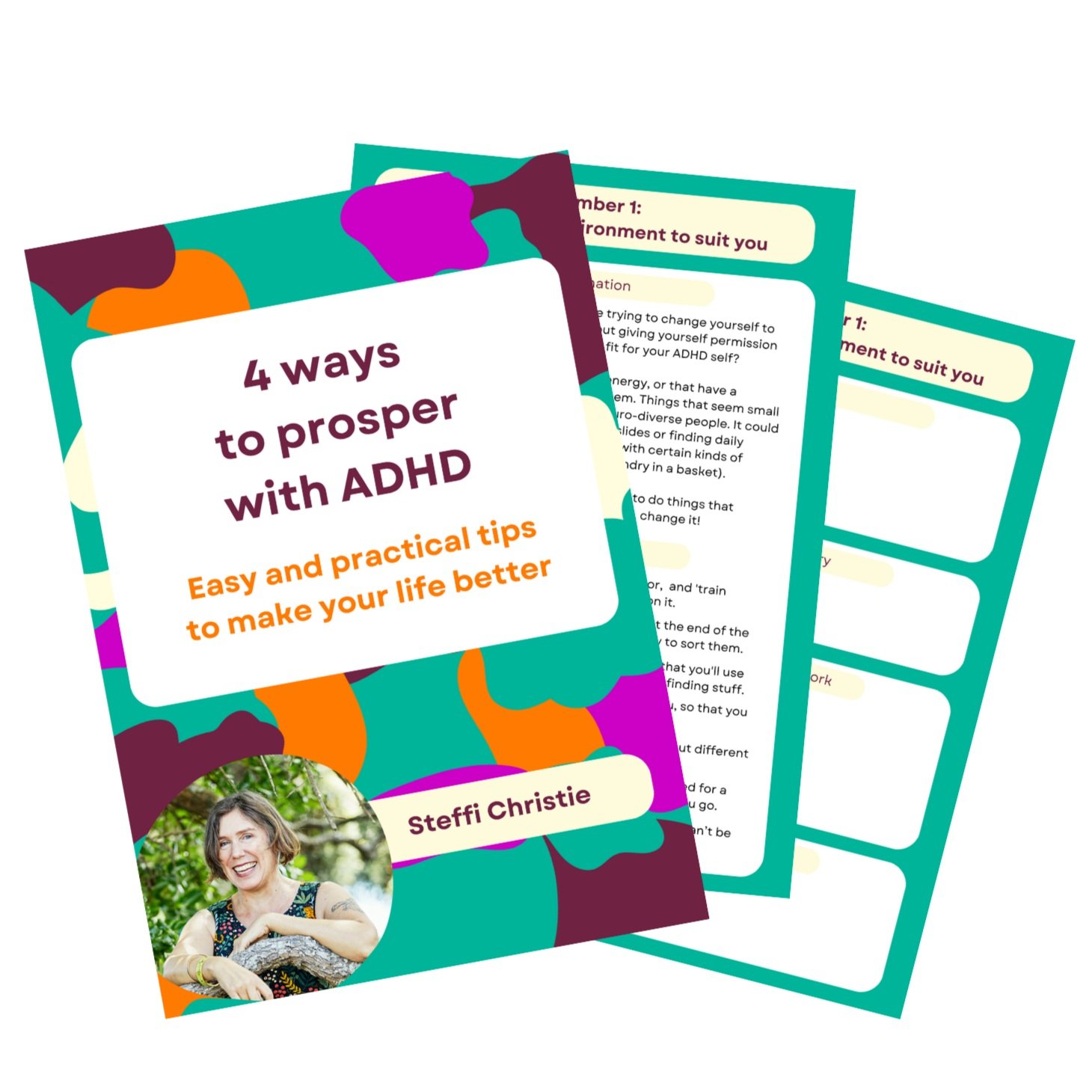
Sign up to receive my newsletter, along with a free copy of my ADHD workbook, “4 ways to prosper with ADHD”. I’ll be in touch with strategies, stories, and research, and Interesting Stuff.