
How to exercise with ADHD
I speak with a lot of adult ADHDers, and something I often hear is: “I really need to exercise, but I can’t seem to get myself to actually do it.”
I used to hate the word ‘exercise’. Even the idea offended me. Ten thousand steps a day? Hype made up by a Japanese pedometer manufacturer. 30 minutes of heart-beat-raising exercise three times a week? Not actually based on any specific research but endlessly repeated. People sitting down all day then driving to the gym? Capitalist madness, fuelled by the exercise industrial complex.
Okay, so this was mainly a tongue-in-cheek rant I indulged in to amuse myself, but I really did hate the idea of exercise. It reminded me of being made to run around the field by disengaged teachers, or being trapped in the school gym while people threw medicine balls at each other. No choice, no point, hot, sweaty, heart racing, and failing at it all.
For a while as an adult, ADHD kept me fairly fit. Fidgeting, going from room to room looking for things, being broke and having to walk everywhere, climbing on the playground with my toddler, moving house for the third time in a year - all these things kept my body active. As I got older, and learnt how to get jobs where you get paid to sit still, I started to need more movement. But it took me a long time to notice.
A lot of ADHDers use exercise to self-regulate or ‘medicate’ themselves. I’m more on the dreamy, inattentive side. (My life motto as a teen was ‘Coffee and The Conservation of Energy’.) Up until my late ADHD diagnosis, I was always anxious, struggled to sleep, and felt most of the time like I was walking through invisible treacle. Why would I want to add in the stress of getting myself to exercise?
At the same time, I loved long walks in the bush, dancing for hours at a gig, or biking to the river for a swim. While everyone else was snuggling to watch a movie on the couch, I’d get up every twenty minutes to do…I don’t even know what. The restlessness builds up, and the limbs follow.
It was during the early-pandemic nation-wide lockdowns that I became of my body’s itch for movement. I think it took those four weeks of forced quiet for my nervous system to calm down enough for me to feel the sensation. I decided that I wanted to do some kind of intentional movement every day. That was when I invented the ADHD strategy that I share in this blog post.
With my growing knowledge of what works for adult ADHDers, I added extra supports - positive emotions, extra motivators, and changing my story about me and movement. Over time, as I taught myself that moving my body really does feel good, I became able to build movement into lots of moments in my day. It’s taken time, but I can now tell you, hand on heart, that I love to exercise - as long as I get to define what ‘exercise’ means for me!
Exercise is really important if you have ADHD. I bet you knew that already. So why is it so difficult for a lot of us to actually get ourselves to do consistently?
Maybe you finish your day of work and you can hardly talk, let alone get yourself to the gym to pump weights for an hour. Maybe you meant to walk in the middle of the day, but your work colleague ended up in your office in tears again, or your boss sent an urgent out-of-the-blue demand, or you got distracted on the way to the bathroom and now you have no more lunch hour left.
This post is for you if you struggle to consistently get enough movement in your day. I’m here to tell you: you CAN do it, and you can do it your way. This post isn’t about what exercise to do. It’s about how to get yourself to exercise when you have adult ADHD. I understand how tough it can be, so I’ve made my ADHD-support strategy into a printout and process for you that I hope will help.
The aim of this blog post is to help you to get yourself moving and to feel good about it. We’re not aiming for your perfect exercise routine. Maybe that will happen over time. But we always have to start exactly where we are, and take the next step - in this case, perhaps literally as well as metaphorically.
ADHD exercise challenges
The things that made ‘exercise’ hard for me are pretty typical for many of us with ADHD-type brain patterns. If you were to go back in time and ask me what stops me exercising, this is what I’d have said:
It’s seems boring
It’s only for my benefit, so it doesn’t feel motivating
I have bad associations with it from school days
I think it’s going to be painful
I can do it once but then the next day I can’t motivate myself
I don’t like the sensations of it
I don’t relate to the identity of a sporty type
I forget to do it
I plan to but then it’s too hot/cold/rainy/busy
I feel too tired
I had a good routine but it got disrupted and I stopped
I have a vision of the perfect exercise routine but I can’t get round to it
I can’t find my shoes/hat/headphones
I don’t have time
I don’t like it
What a list! No wonder I hated the idea of it.
At the same time, I loved walking, swimming, dancing, and riding my bike. I was stopping what I was doing every twenty minutes to move around (often to look for something, or to tell a story that required big hand gestures, but still, doing movement.) But I didn’t count these things as exercise.
I often discouraged myself from doing the movement I enjoyed because I thought I shouldn’t do ‘fun stuff’ until I’d done ‘the actual important stuff that I’m procrastinating on’. This is very common among adult ADHDers! We are often more interested in helping others than in the noble-but-dull-sounding ‘taking care of myself’.
Your lifestyle as a grown-up may include less natural movement than it used to. Sometimes you get to a point where you need to actively take care of your body, so that your world doesn’t shrink. But we know that telling yourself ‘you just should be able to do it’ doesn’t really work. So we’re going to approach it in a different way - one that suits your ADHD brain.
Work with your ADHD
First, an interesting question. What exercise or movement are you doing already?
Why do I bother saying this? Because often we tell ourselves that when it comes to exercise, we can’t control our actions, can’t choose to do what we want to do, aren’t doing enough, and so on. But when you want to get motivated with ADHD, feeling empowered matters.
It’s like this weird-but-mostly-true maxim: it’s easier to save when you have some money saved already. Let me explain. If you have an overdraft, being $100 in debt is generally not practically that different from having $100 saved in the same account.
But if you’re wanting to build up money, already having $100 saved really helps. It encourages you, so you feel confident and motivated to save a little more. (Obviously, there is also the risk of feeling excited that you can now spend $200 on Warcraft miniatures, but let’s not take my metaphor too far.)
Many adult ADHDers have dealt with the mysterious workings of their ADHD brain by paying a lot of attention to everything they do wrong. Once you can look at yourself through an ADHD lens, you begin to understand why some things work for you and others don’t. This means you can start to set things up so you can do what you want to do more consistently.
Sometimes it takes a while for our stories to catch up. You don’t need to be always kicking your own butt any more. How do you change your stories? One way is to ask yourself to regularly pay attention to your strengths, your values, what supports you, and the stuff you already do that works.
Your brain isn’t likely to spontaneously start doing this. You have to train it to do it (later it will probably start doing it on its own). One way is by celebrating.
Another way is by noticing what you’re already doing and ‘catching yourself’ doing something that you want to do more of. Then you can say to yourself, Hey, good job! It may feel strange at first, but if you keep at it, your brain is likely to give up resisting and actually feel a little buzz of reward. So I encourage you to ask yourself: what movement are you already doing?
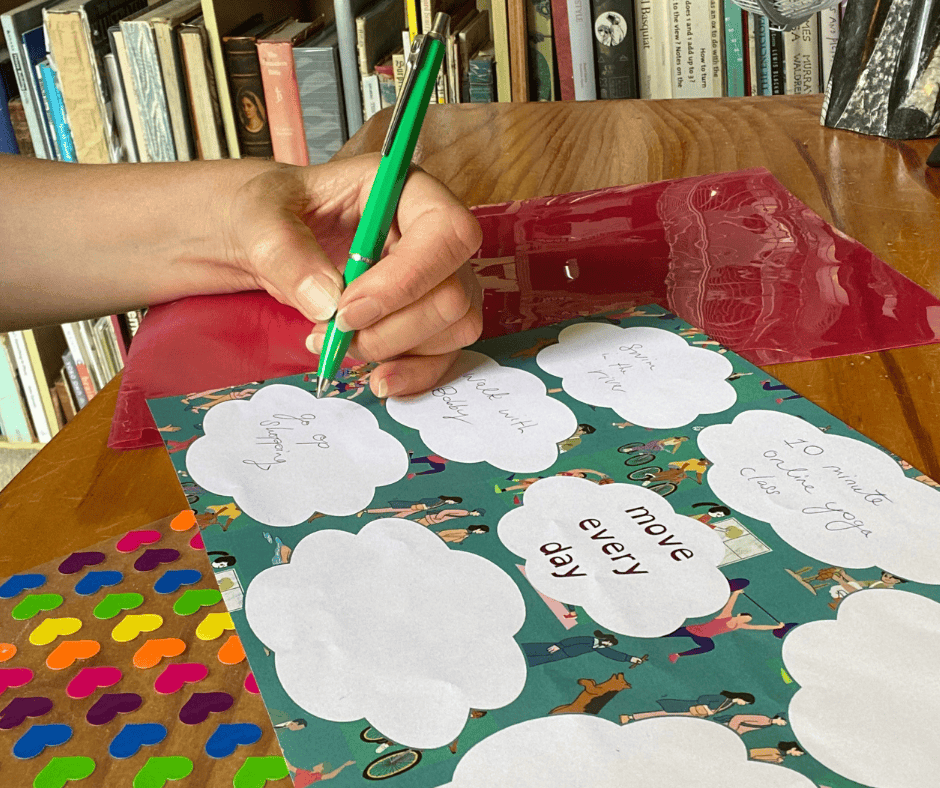
The other part of noticing the movement you already do is that you may be able to do gentle extensions of those activities. They may even be the seeds for an activity that goes on your ‘move every day’ poster, if you decide to try it.
Movement and ADHD masking
We live in a world where people sit down a lot. We’re encouraged to stay still, to keep our legs from jiggling, and to not touch the cafe’s Christmas decorations. (They were so glittery, I couldn’t help it.)
Unmasking with ADHD often focuses on speaking with more honesty, asking for sensory accommodations, or pushing back against unnecessary admin. These are all brilliant. However, I haven’t seen many people talking about something I experienced as I unmasked - my fear of (and the reality of) social awkwardness caused by me moving in the ways that I want.
A turning point for me was going to a workshop on a healing modality. Normally I’d put a lot of energy into staying still and monitoring my facial expression, so that the facilitator didn’t feel worried that I was bored or unhappy. This time, I decided to allow myself to move as I wanted. I wriggled, I had my fidget toy, I went for walks on every break, and I moved around the room whenever we got the opportunity.
I felt so relaxed and focused and present. At the end of the workshop, I went to thank the facilitator. She said to me: “I noticed your nervous system was really activated.” Whaaaaat?!?
It was such a stark contrast to my experience! How timely to be given such a clear illustration of the ways that I’d been encouraged all my life to mask my natural movement patterns, This realisation made it easy for me to commit to moving more in the ways that feel natural to me.
Now I’m a believer in what I like to call ‘fidget fitness’. This is where you allow your body to move as much as it wishes without doing anything illegal. It could be by standing up in meetings, dancing about while waiting in the supermarket checkouts, having a treadmill that you use while on the computer, or popping out to see what’s going on down the street.
It includes alternating sitting-down-type work with a physically active break. Movement is energising! The added bonus is that if your break from work includes a little physical task like putting away the dishes, you get some happy drugs in your brain from the task completion.
Cardio and ADHD
After using the strategy that I talk about below, I got used to moving my body in an intentional way every day. Then I found that my body started to clearly ‘tell’ me when it wanted more movement.
This was when I joined the gym that’s in walking distance from my house. (Recently someone who has known me for a long time said: I saw someone like you walking along in exercise clothes, but I knew it couldn’t be you! But it was.)
This is where I discovered a strange secret…
Cardio exercise releases happy drugs. Amazing! For me, this happens within minutes!
Why didn’t anybody tell me? I genuinely thought people were doing cardio to be ‘good’. But it turns out that many of them are doing it to FEEL good, which is much more motivating to me.
Generally, doing movement that raises your heart rate a little:
Helps you sleep better
Helps you focus
Helps you tolerate potential heart rate increase on ADHD medication
Helps regulate your nervous system
May help you calm down if you’re hyperactive
May give you more energy if you’re inattentive
Helps your mood
Feels good
Things that increase your heart rate include walking around the block, mopping the floor, climbing up steps, hula-hooping, and trying on ten items of clothing at an op shop. I tell you this so that you can expand your sense of what you can call ‘cardio exercise’.
If you want to get the cardio buzz, you may need to up the ante a bit - walk up a hill, tidy like the Tasmanian Devil for ten minutes, swim twenty laps, or bounce on one of those cute little mini trampolines.
You can work towards this. Gyms are full of opportunities to give yourself the cardio glow, but best to get in the habit of moving daily, then add that membership in if you want to. Otherwise you’re one of the many paying for the few people who actually make it there!
It’s useful to note that there may be things about cardio activity that make you feel uncomfortable or unsafe. There may be a sensory element or strong associations with some of the sensations. I resisted trying cardio exercise for the longest time. I hated sweating!
For one thing, it reminded me of being coerced into running round the field as a kid. Also, it was a sensation in my body that I wasn’t used to. And having a raised heart rate was something I associated with my history of panic attacks.
Once I realised that the sensations of cardio exercise were off-putting for me, I decided to teach myself that these sensations are safe and chosen. How did I do this? Very gently!
I had to teach myself to get used to the sensations of having an increased heart rate. I found gym machines that would tell me my heart rate. I would exercise on them for a few minutes and notice how I felt in my body, and how that related to my heart rate.
This let me feel in control of the process. Just as importantly, it made me curious about what was going on. Over time, my sense of what ‘safe’ feels like expanded.
Changing my mind
A vital part of me exercising more was taking the time to change my attitude to exercise. I had so many negative emotions tied up in the word ‘exercise’.
The first step for me was swapping out the word ‘exercise’ for the phrase ‘intentional movement’. This gave me an opportunity to make new meanings for my new phrase. That’s how I came to accept that, in the right circumstances, I enjoy moving around and it gives me energy.
When I feel too tired to do any kind of intentional movement, I find it helpful to ask myself: Am I mentally or physically tired? If I’m physically tired, I probably don’t need to do any more movement. But usually I’m only mentally tired, from emotional, social, intellectual, or executive functional exertion. My body still has lots of energy.
This helps me redefine the challenge - how do I get my body into motion, given that I have very little mental energy left to motivate myself? This helps me find ways forward - maybe put on music, listen to a stimulating podcast while I walk to the park, or ask someone if they want to go for a swim with me.
Adding ADHD motivation
Learning about my unique ADHD brain has helped me exercise. I need my rewards right away, and I avoid demands. This means I need my movement to be enjoyable, and I need to give myself the choice to do it or not.
Using my ADHD gift of problem-solving, I’ve been able to find ways to exercise that work for me - for now. At some point this is bound to change, but I can go back to what I’ve learnt and find a new solution.
You may be motivated by other people, by star charts, by booking ahead, by training for a big event, or by competing with yourself. Looking for intential movement activities to try means asking yourself: how can I combine some of the factors that motivate me?
These are some of the factors that work for me:
Things where I have to book ahead, and if I don’t turn up, someone else misses out
A place that I can focus on getting to as my aim, then once I’m there, the place kick-starts my momentum
Having all my stuff for the activity in a bag so I can find it without being frustrated
Being able to walk or bike or drive there easily depending on weather conditions
Strong positive emotions about the activity, which I carefully grow and take care of
Having my earphones and a special podcast or music playlist that I listen to when doing the activity
Allowing myself to have phases of being into particular things and not others
Here are some other factors that often work for adult ADHDers:
Hiring a personal trainer
Taking part in a bootcamp
Having a buddy (can be online or body doubling)
Using apps that track your walking as if you’re walking across Middle Earth and so on
Interestingly, researchers have examined the ways that we turn experiences into memories. From the results of these studies, I created these rules-of-thumb for myself. Make sure that your experience of intentional movement:
feels good most of the time
isn’t overwhelming or too uncomfortable at any point
ends in a good-feeling way
This helps you to remember the experience as positive, making it easier to do again another time.
Finally, I make sure to appreciate the positive difference that intentional movement makes for me. If I’m able to climb up a steep track to swim in a waterfall, it’s because of the practice I have of making sure I move every day. On the days when I feel like intentional movement is pointless, connecting the two activities in my mind helps to keep me motivated .
What will I do?
You are unique, and your exercise needs and options are unique too.
If you choose to try out the printout, you’ll be writing down some activities that involve intentional movement.
Here are some other factors that can help too:
Things that make you fit for the life you live
Things that are fun, interesting or meaningful for you
Things that include nature
Things that give you some social contact
Things you can do regularly at set times
Things that give you novelty
Things that give you a feeling of progress
You might want to think about a range of types of movement, such as something that raises your heart rate, something that activates your balance, some stretching, or something that builds strength. But please remember that the point of this is to get you moving and feeling good about it, rather than making a perfectly balanced plan that you don’t actually use.
It helps if everything on your list is something you actually want to do and can do easily. On that note, please choose activities that are ‘the short version’. An hour-long run might be your dream, but if you currently only do that once in a blue moon, it’s better to put down ‘ten-minute run’.
This ‘all-or-nothing’ perfectionist thought trap is so common for ADHDers. It may be the way motivation for exercise has worked for you in the past, and you’ll probably find yourself able to use that motivation again at times in the future. At the moment, though, you need a different way to motivate yourself - an ADHD strategy - with low demands, high rewards, and a simple rule: ‘do some movement every day’.
Once you get started on your movement for the day, it’s fine to spontaneously do more. But if at the outset you try to convince yourself to do too big a task, your brain may reject it. Over time, this is likely to lead you to avoid even asking yourself to do intentional movement.
Finally, my belief is that your personal fitness is about being fit for YOUR life! You get to choose what this looks like, for your current situation. Forget about the influencers, your imagined frenemies, or what your sister thinks you should be doing. You get to choose.
Using the printout
Here are the steps for using the printout:
Brainstorm potential activities
Choose some activities and put them into the empty spaces on the printout
Think through each activity - how can you support yourself to do it?
If you want to, set up a way to reward yourself or track if you’ve done an activity
Put the printout on the wall in a place that you’ll notice it (or make your own version)
Every day, pick an activity off the list and do it
See what happens!
Adult ADHDers often struggle with the executive functions of memory, planning, organisation, and getting started. This strategy aims to set up external supports for the days where your brain isn’t doing this by itself, or is only using the executive functions when it comes to making rainbow jelly, or another current obsession. (Yes, I’m currently finding it all too easy to focus on making rainbow jelly.)
The secret sauce of this technique is that you aim to do something - anything - that counts as ‘intentional movement’ every day. That’s it. It’s clear whether or not you’ve done it. There’s nothing tricky to remember. If you get to bedtime and you haven’t done anything, you can still put on your favourite music and do a few interpretive dance moves!
There’s novelty, because there’s a range of activities to choose from. There’s also certainty, because you know the activities and have already smoothed away obstacles.
Crucially, you get to choose what you do on any given day, so you don’t need to rebel against yourself. And hopefully you’ve written down things that you can feel a positive emotion about, so you’re luring yourself instead of pushing yourself.
Here are some ideas about what might go on your list:
Dancing
Gardening
Going for a run
Going on an adventure
Walking in the bush
Dog walk
Yoga
Kapa haka
Tai chi
Karate
Swimming
Biking
Cleaning the house
Walk around the block
Playing outside with the kids
Please feel free to create your own version of this printout! You might want to change the words, include images, or do it with felt pens. The point is to have something physical that you put on the wall. Why? Because ADHD brains like visual reminders and clear instructions.
Enjoy moving every day
If you use this printout, please feel free to get in touch and tell me how it goes!
I love recognising how much I enjoy movement now. I love finding opportunities to move during the day, and I love how moving around gives me energy, helps me focus, and improves my sleep. I hope this blog post inspires you, and gives you practical ideas on how to add intentional movement into your life, every day.
At the moment, you may think that ‘exercise’ sounds virtuous, painful, boring, and impossible. I believe that exercise, or intentional movement, can be a source of great joy, meaning, and interest for you. Yes, you! If I can do it, you can too.
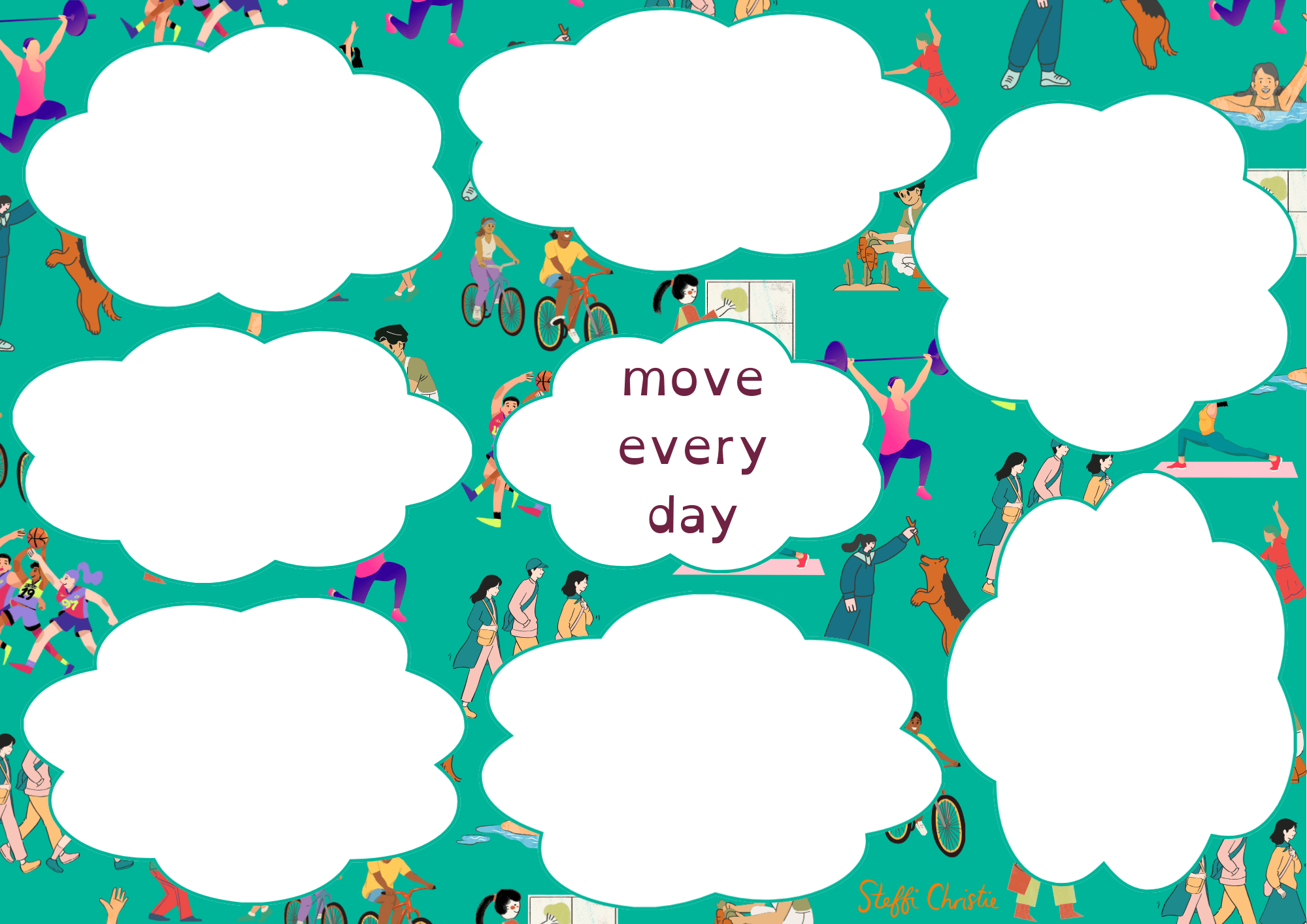
ADHD exercise support strategy - download and print, or make your own version!